


The garden’s healing force
There seems to be a broad assumption that our internal world and our external world are two separate things. When struggling with depression, anxiety, or burnout, we often want to analyze ourselves, fix our thinking, or get some medication to help the brain function seamlessly. We walk around like a brain on a stick believing that when our mood changes, or we feel something we don’t want to feel, our brain can think its way out of it. We assume that a physical problem needs a physical solution and a mental problem needs a mental solution. It makes logical sense. But I want to propose another healing agent: the natural world around us. More specifically, the garden right outside your front door.

Being outdoors makes you feel good. Hearing the overlapping songs of birds swooping from trees, noticing the settlement of minerals in the rock formations of a canyon, plunging your hand in the soil to mix in compost, denting the surface to plant a seed. Is there anything more centering?
Human beings are the only living organisms that need to “go be in nature.” Most of us live in a tidy air-conditioned space, and when we’re ready to engage with nature, we plan a trip to a park, we go on a hike, get in a kayak, or plant a seed in the soil. But we have that wrong. We don’t visit nature; we are nature. It’s so simple, but we forget. There is a strong connection between our outer world, our relationship with the natural world, and our brain and body chemistry.
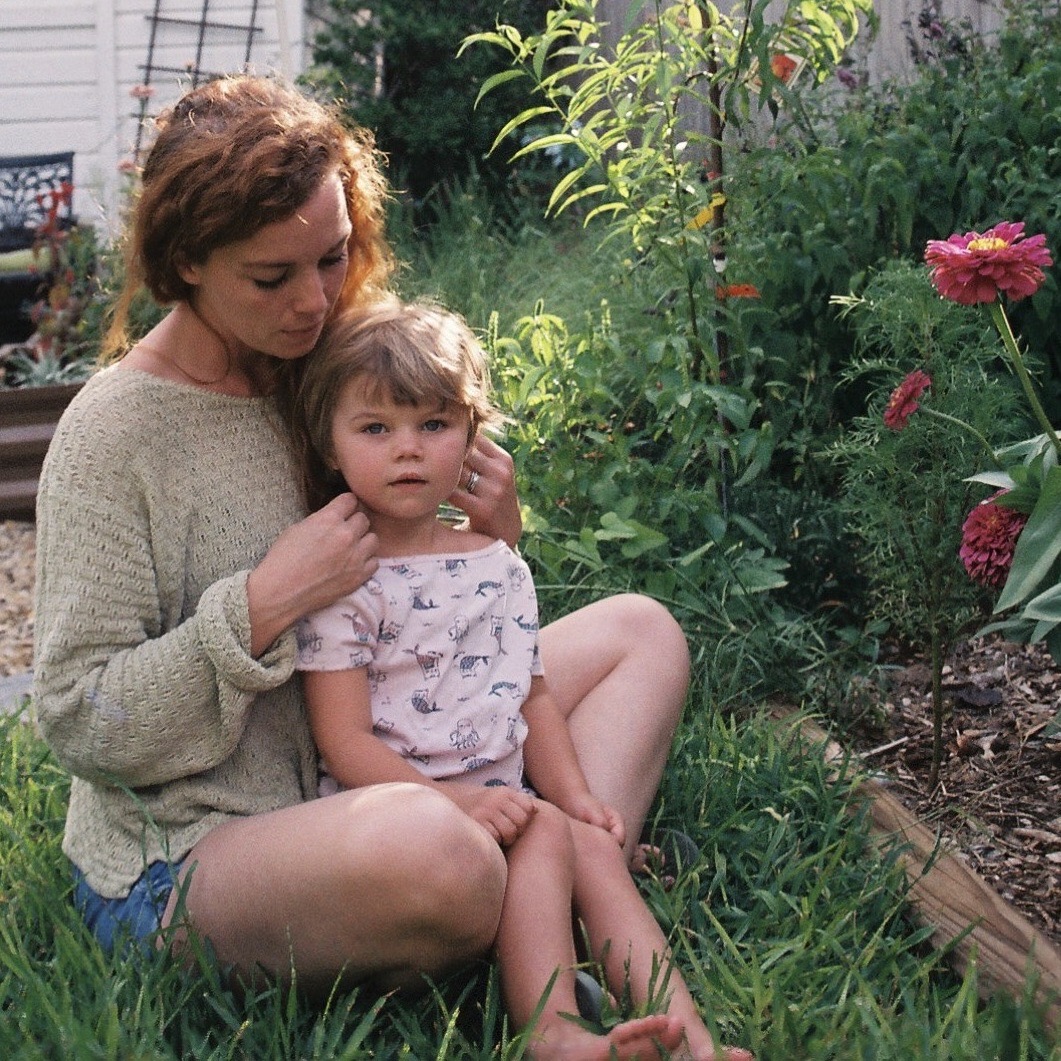
In my own life, I have been on a path toward understanding this more fully. It is a simple truth, that we are nature, and that nature can heal us. And yet, so many of us partition it off from our daily lives. This is why I decided to pursue horticultural therapy. To read the full article published in the Dallas Morning News, click here. (you have to have a DMN subscription to read it) And see below for some simple garden activities to begin to engage with nature in a new way.
Here are two practices you can do in your garden space that may help you in your personal growth. For the purposes of this exercise, a garden space just means: your backyard, your back porch, your patio, your courtyard, or a balcony with a potted plant. It can be 12 square feet or half an acre. Remember that we don’t go into nature, we are nature. It is all around us and it is in us. Therefore, it is the most natural thing in the world to be present to your natural surroundings.
A practice for someone who is burned out, stressed or anxious.
Description: Burn-out and stress can be caused by a mismatch of your values and gifts, and what is asked of you in your daily life. We often have to devote our attention to a task that we are too tired or ill-equipped to handle. A person who is burned out and stressed out is longing for some restoration and mental rest. In nature, we can use “involuntary attention” to create a sense of relaxation. Involuntary attention is what happens when you sit on your patio watching the birds or mindlessly weed your garden. You are just aware enough of the task at hand, while the rest of your mind gets a breather.
Reflection:
Check in with your body as you begin this practice in nature. What are you carrying with you into this moment? Where do you feel it in your body? Try not to analyze yourself, or fixate too much, and try not to solve any problems mentally. Take a breath and picture breathing into those tense places in your body. After the nature activity, return to this exercise. See what has changed and check in with your body again.
Activity:
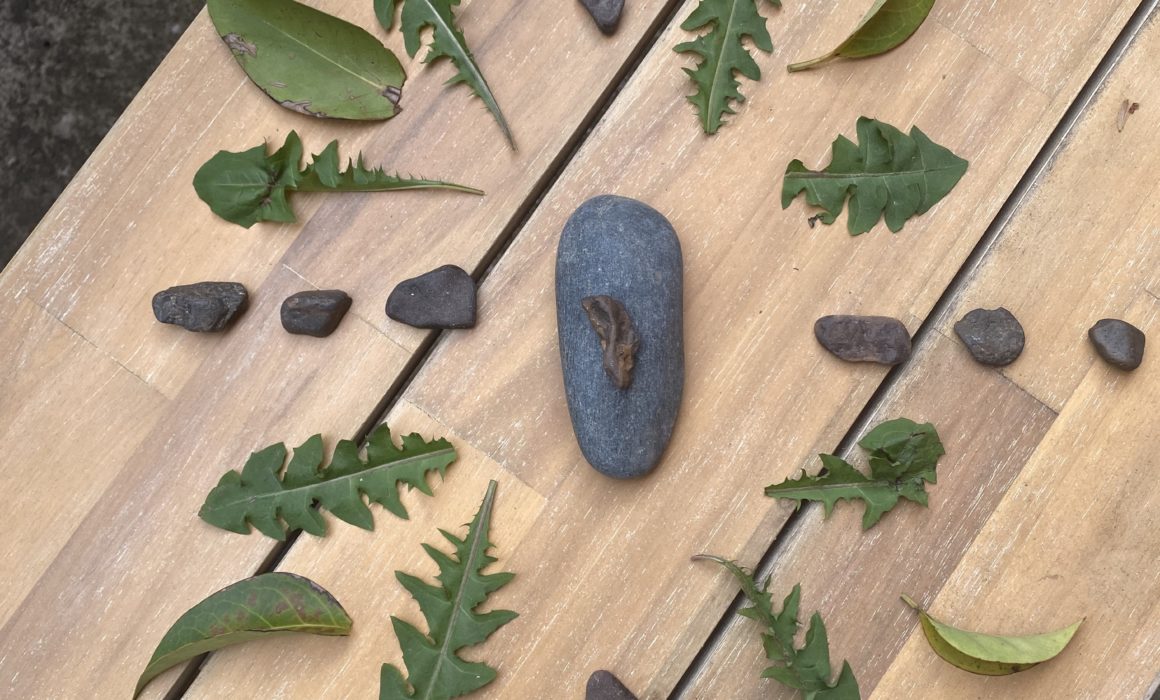
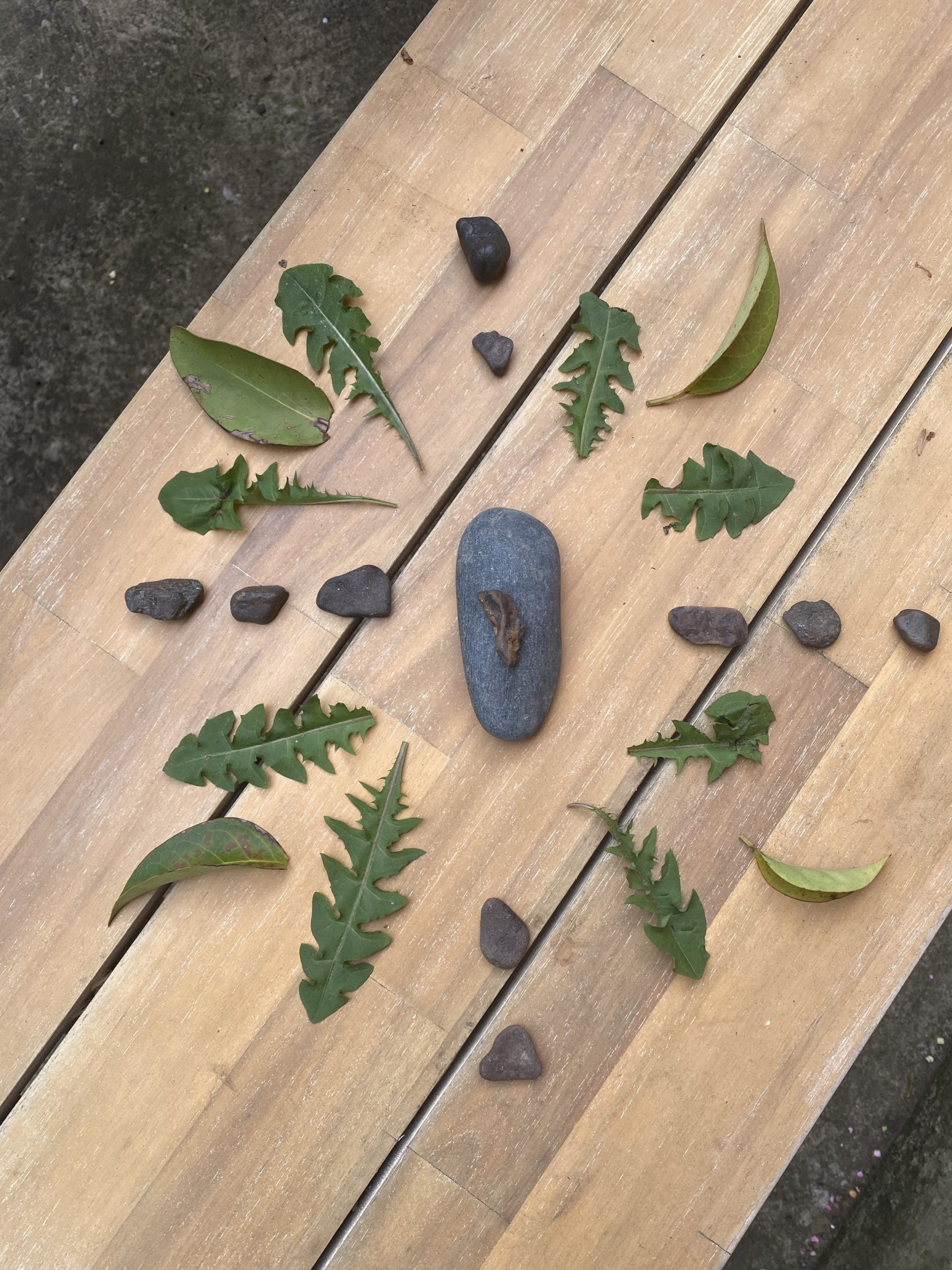
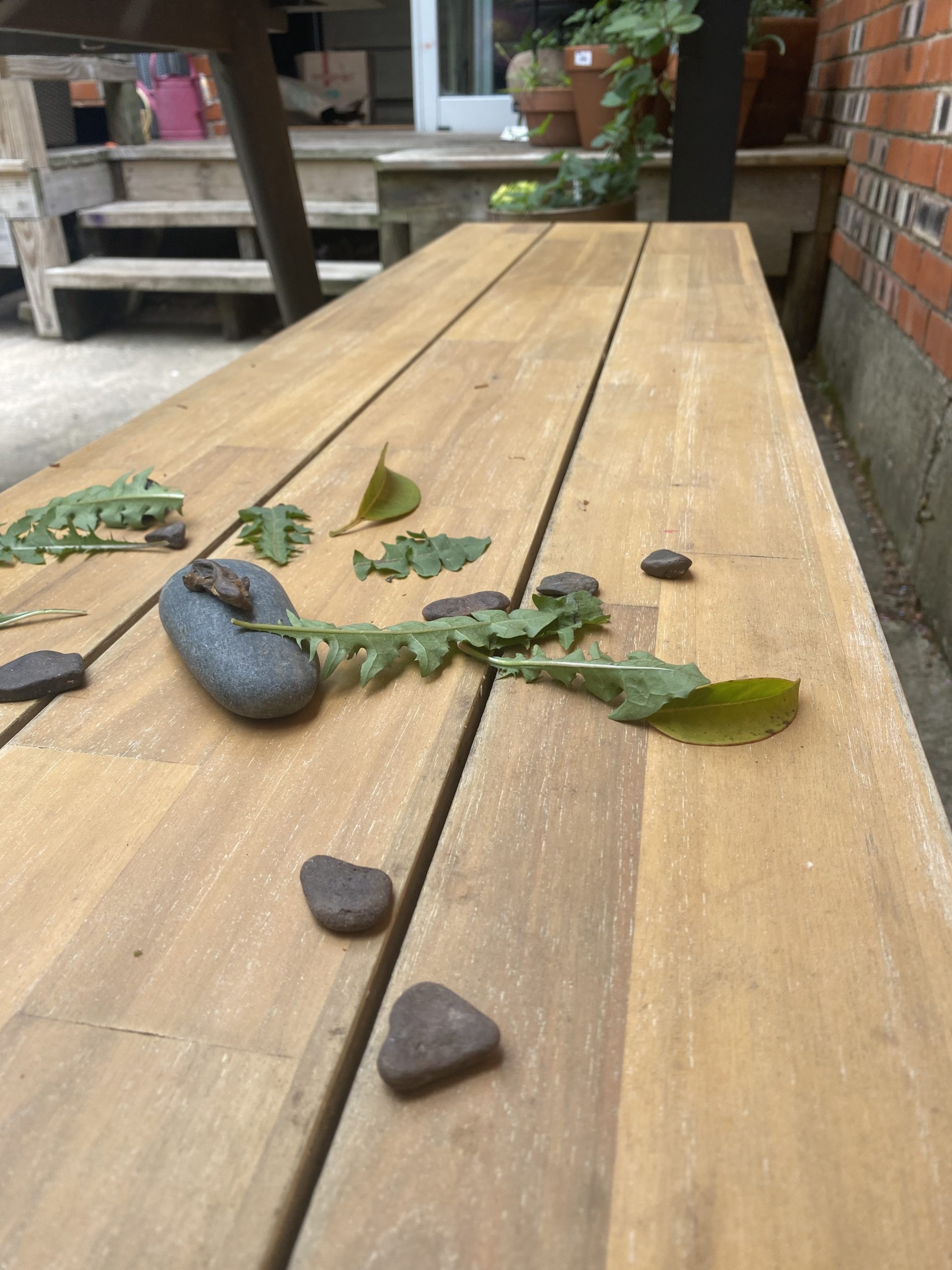
Go throughout your outdoor space finding leaves, flowers, sticks, and petals. Whatever material you see. See if you can get one piece of plant material for every item on your to do list. Or choose one to represent each burden you are carrying today. As you lay them out, think about how you can release your worries and open up your grip of control over your life. After you have finished laying out the design. Take a moment, then blow them all away as a symbol of letting go of your stress.
A practice for someone who is depressed or grieving.
Description:
Depression is a complete lack of hope for the future. There is a felt sense of permanence to it when you are in the middle of it. I often notice that the more a person attempts to pull themselves out of it by thinking more positively, it only shines light on how powerless they feel to do anything about it. For those reasons, this reflection and activity focuses on acceptance and acknowledgment of depression.
Reflection:
Take a moment to acknowledge your depression. It might feel like discouragement, sadness, grief, or disappointment. What does it feel like today? Write that word down. Let yourself feel it for a moment. Remember that emotions aren’t permanent, they come and go live the waves of the sea.
Activity:
For this activity you will need a seed or small plant, soil, small pot or space to plant and a small piece of paper towel or toilet paper.
On the piece of paper towel or toilet paper, write one hope you have about yourself even as you are experiencing depression. This can be something concrete: “I hope this plant grows.” Or a deeper longing: “I want my life back.”
Place your paper in the bottom of the pot or in a hole in the ground. Plant it in with the plant or seed. When you start to grow something you cultivate the seedlings, but you also have to trust that the water and sunlight will make it grow. In the same way, we set our intentions for our own growth and healing, but we have to trust that healing happens in its own time, and our body and mind will find a way through.
Morgan Myers is a family counselor in Dallas. She wrote this for The Dallas Morning News.

For Us Givers at Heart
Some filtering questions for those of you who are Givers at heart (and maybe sometimes over-functioning) 🙂
Many of us (we therapists know we’re In this category too!) find ourselves giving beyond our means and in ways that are unsustainable. People sometimes take more than they give back. And there is always a need that arises among the people we care about. We can find ourselves running around trying to meet these needs and we can get so tired and drained! We sometimes don’t stop to think if it’s something we want to do or something we can do.
If you relate to this, here are a few questions to ask yourself that might help you filter through these situations. Sometimes you can give sacrificially to others and sometimes you may need to practice saying no to others and saying yes to yourself and your needs.
Sidenote: We believe the end goal in our relationships is to be generous to others in a sustainable way. We aren’t advocating for you to be self focused, but to tend to your needs so that you have more to give to those around you.
So ask yourself these questions:
- Is the person asking for your help? Sometimes when we hear about something difficult we want to fix it. But sometimes people don’t need anything from you than just to listen.
- Do you have it to give? Do you have the food in the pantry to be able to make someone a meal? Do you have the time to sit and listen to someone without being late something else? Do you have the patience and energy to give to this person without losing patience for those that you know you must give it to (aka your kids or spouse)
- Can you give joyfully? Without resentment or bitterness.
- Can you give without expecting something in return?
This feels like a sucker punch even as a write this, but when I’ve tried to follow my instincts with how much I can realistically give I end up feeling more rested and centered. Try this out and see how your emotional (and financial and mental) reserves seem to change.

What’s the difference between fear and wisdom?
It’s hard to know the difference between feeling unsafe or uncomfortable and when we’re actually in danger. When we feel unsafe we’re bringing in our past experiences and our anxieties. But when we’re in danger we’re actually at risk.
It’s important to define what wisdom is and what it sounds like to you. As situations come up and you have to make a decision, wisdom will always lead you with courage and caution. Here are some helpful ways to differentiate fear and wisdom:
- Wisdom can take a calculated risk- it can imagine a positive outcome, as well as an unfortunate outcome.
- Wisdom is slow and reflective.
- Fear is reactive and visceral. It can’t image a positive outcome and gives you tunnel vision.
- Wisdom is the path that leads to more joy even if it’s uncomfortable sometimes.
- Fear leads to anxiety and hiding.

So for you, how do you know which mode you’re in?? Take a moment and write down what fear feels like in your body, how do you show that you are afraid? Is it jumpiness? Tension in your neck? Shutting down? getting busy?
What does fear sound like in your head? What do your thoughts sound like? Racing thoughts? Overgeneralizing the negative outcomes? Triggering past memories? Maybe it’s minimizing the risks and you fight through it? Not stopping to consider the possible outcomes?
Then take a moment and ask yourself what does wisdom feel like in your body? How does it express itself? And what does wisdom sound like in your head?
We can all be led to take calculated risks and embrace change when we understand what wisdom feels like and what wisdom sounds like. We can also be led into hiding and anxiety if we let fear take control. But between the stimuli and the reaction there is space to choose. You can choose wisdom and joy!
If you want to process your fears and how you make decisions reach out to us! Email us at morgan@eastdallastherapy.com or click here read more about us.
Deconstruction is Destabilizing
Deconstruction. What does that mean? We don’t see deconstruction in every day life. The closest thing might be ground zero, an imploded building or a bunch of computer parts pulled out. What is deconstruction anyway? I think we all hear about this word a lot and I haven’t seen many able to reconstruct after the destruction, hmmmhmmm I mean deconstruction is done.

It is very destabilizing when people begin to take away long held beliefs that once provided a firm foundation to your identity. Everything comes into question. Questioning these things coupled with shame that usually originates from the church, makes it difficult to distinguish what we really believe anymore.
With my clients we talk about holding on to those aspects of faith and religious life that still feel authentic. Not just those things you “make yourself believe” but those concepts and beliefs about God that feel real and essential. Deconstruction can often feel like you are tossed from doubt to shame to anger to bitterness to doubt again, then grasping for hope and finding it is ill-fitting for the present version of yourself.
One thing that has seemed to help people walking through this time is to ask,
What do you know? What do you believe? What seems important in your spiritual walk?
I know there is a lot you don’t know- a lot of uncertainty. Take away the shoulds. Let yourself express those beliefs you hold now.
I’ve never encountered someone who couldn’t come up with at least one belief that remains. Even if it’s more ambiguous than it once was, or more gray. It’s ok. You can’t should your way through deconstruction. You have to let yourself be right where we are.

Our Nerves Are Fried
Our nerves are fried.
It’s been one of the most challenging years. We have faced a lifetime of ups and downs within the span of a few months. If you are squeezed in any one essential area of life it can feel like your whole foundation has been rocked. These essential areas are what we build our lives on: our financial security, our health, our close relationships, our view of God, our views of the world. They have been flipped on their heads during the pandemic.
And now we’re facing a second or third wave of COVID. Which brings a second or third wave of fear, anxiety, hyper-vigilance, outrage at our politics, and uncertainty about our future.
We’re all feeling it.
Even in the middle of the fear though, we have to remember we’ve been here before. We learned some things the first time. If we hadn’t learned to cope with this the first time, we would still be curled up in a ball on the floor. Maybe we did curl up in a ball for a bit. But we figured out how to get back up.
So I wonder, what helped you get back up? What fear did you learn to soothe? What white hot anxiety did you learn to abate? Remembering that can help you this time.
I think it has something to do with bringing your attention to what you can control. For me it’s this belief: If my family, my kids, my garden, and my dog are here with me, I’m ok. I can be ok when the world is not ok.
I can be ok when the world is not ok.
It could be this:
Other’s judgements and opinions have nothing to do with me. I don’t have to doubt my decisions because someone else does.
I don’t have to doubt my decisions just because someone else does.
Calming Anxiety by getting out of your head
[The] Present moment is filled with joy and happiness. If you are attentive, you will see it.
Thich nhat hanh
I love to think of mindfulness in this way. Mindfulness has become a buzz word lately and we have overcomplicated its meaning. It seems like we’re all trying to achieve this kind of joy by being more present, but the funny thing is, being mindful is one of the most intuitive parts of our human nature.
I was walking on a South Carolina beach recently thinking about how people who live near a beach must not struggle to figure out mindfulness. It’s built into their lifestyle. To experience beautiful spaces is to live with constant opportunities for mindfulness. But we don’t have to live near a beach to experience this. We can embrace the beauty in our lives and experience the the intoxicating effects of sitting squarely in your present setting. We can all think of times we have been fully present in the moment and it usually involves something beautiful or something that reminds us of our place in the world. I also like to think of mindfulness as a way of engaging our senses.

To experience beautiful spaces is to live with constant opportunities for mindfulness.
Here are a few ways to practice mindfulness and to get in touch with that part of your nature that wants to be present. Start with engaging your senses…
Sight: This can be as simple as stopping and looking your husband in the eye when he walks in the door and remembering why you love him. It can also be sitting at the lake and watching the water move and the clouds fade.
Hearing or sound: Sitting near any body of water can lull you just like our white noise machines in our bedrooms. I found myself sitting in the next room during the holidays listening to all the voices and the fullness of the house we were staying in. Sitting on your back porch and listening for birds or someone walking and crunching the gravel in the leaves. This can be turning music up so loud that it fills your body with vibration.
Taste: Have you ever noticed when you can take your time cooking a meal? It can be the most relaxing thing to have those activities that engages every sense. You’re smelling the fragrance, you’re seeing the colors and the shiny oils covering your food, you’re tasting each note of flavor you’ve added, you’re holding smooth carrots and a warm pan in your hand. If you don’t have time to cook, you can also do a chocolate meditation. One of my clients told me she does this locked in her pantry so her kids don’t get any!
Here’s a link to a chocolate meditation
Smell: This is smelling the oils emerging from your diffuser or sitting with your daughter and smelling her hair. This is going for a walk and taking a deep breath, allowing the smell of pine to relax your body.
Touch: There are many ways to be mindful with touch. You can pause and use a stress ball to squeeze and feel the sensation on your hands or you can use meditation to notice the sensations you feel in your body.
Here is a link to one of my favorites. Notice the places in your body that feel the most tension from the top of your head to the bottom of your toes. You then place your hand there, connecting your sense of touch to that tension. I like to go a step further and name what that tension is. It might
be fear, anxiety, sadness, etc.

I hope that we can all learn to make mindfulness a way of life. I think we can over complicate it, thinking we need a retreat in the woods or an hour yoga session to be mindful. But it is a moment by moment practice of being aware of your body and the ways that you take in the world around you.

Family and COVID and Boundaries and Christmas

I wrote on this topic last year. I am just coming back to look over what I wrote for Christmas 2020, and it strikes me how much has changed. So much of our emotional experience has had to stay beneath the surface since the world turned upside down. We haven’t had the chance to process all that we have just experienced. But those emotions are still there: the uncertainty about the future, the self-doubt in our decisions, the fear, and the outrage at other’s decisions about politics or wearing a mask.
Not only are we processing the Covid-world, but the holidays always stir up our past family experiences. We can be sent back to that child-version of ourselves when we get around family. (You can read more about this in my post about this from last year) As we try to make plans for the holiday this year, it can leave us feeling frozen in making decisions, or wanting to run away, or wanting to say yes to everything to please everyone.
If there was EVER a time to get clear about what you need (your boundaries), it’s now.
So I encourage you to take a minute and listen to your own voice- what you need. I list a few ways to do this below. It can be so easy to get swept away in our family’s plans or our own fears. So when you think about how to handle the holidays, where to spend your time, or what to say no to, take a pause before you respond. If you’ve already responded and regret it, it’s ok to change your mind. Of course we have to consider our physical health and other’s health. But then make sure to consider emotional health. What your heart might need this year is to celebrate with people safely or what you may need is a quiet holiday with a few loved ones. It’s ok to speak up for those needs.

This year will be the ultimate test in boundaries for us all.
You are forced to speak up for what you need knowing you might disappoint people. You might take more risks and face the judgement of friends. Or you might be more cautious and face judgement from family. But listening to your needs will ultimately lead you to a place of confidence and security. You’ll feel happier and more authentic in your relationships. You’ll be able to be present during this beautiful and restorative season.
If we can be reflective and slow down, we can embrace this season with our whole hearts. So when you have a quiet moment of reflection, here are some ways to acknowledge your emotions during the holidays without letting them run the show:
- In a safe, quiet place (so probably not in the laundry room while everyone is waiting for you to come back so they can open presents), try to identify your fears, anxieties, and needs.
- Remind yourself you are not that child anymore. You have more tools, more control, and more awareness now.
- Reflect on what your own nuclear family needs and make space for those needs.
- Open up your hand to what the holiday can be now so you don’t get stuck in what it used to be or what you imagined it would be. Stay flexible.
- Know the difference between wisdom and fear. Wisdom can take a calculated risk- it can image a positive outcome, as well as an unfortunate outcome. Wisdom is slow and reflective. Fear is reactive and visceral. It can’t image a positive outcome and gives you tunnel vision. Wisdom is the path that leads to more joy even if it’s uncomfortable sometimes. Fear leads to anxiety and hiding.
If you need to process wisdom and fear in your life, reach out. We want to hear your story. Email me morgan@eastdallastherapy.com or click here to book an appointment.
How to stress less during the holidays
How do you relax when you…

We’re all facing stress this year like no other year. It feels like every decision we make could have detrimental consequences and yet many of us are so ready to be with family and relax and celebrate during a season of (supposed) joy!
Over on our Instagram I spoke with a local chiropractor, Dr. Bethany Roggendorf at Family Wellness at White Rock about how to reduce our stress during this season. She talked about how stress hormones like adrenaline and cortisol aren’t “bad” but they can be overactive in our bodies and it’s our job to regulate them.

Here are some of her tips for relaxation:
- Take time for your freakin self! However that looks for you!
- Give yourself grace with your diet and consider not weighing at all during this season.
- Remember its not what you do in one day that matters as much as what you do DAILY. So one day (as in Christmas Day) won’t break your health, it’s those daily choices throughout the year.
- Think about getting OUTSIDE to walk or exercise
- Do low tech or no tech activities.
Some helpful resources on stress
From Dr. Roggendorf
- The podcast Model Health Show specifically the episode 417 where he interviews stress experts
- The Stress Solution book
- And the TED talk from Dr. Kelly McGonagal called “How to Make Stress Your Friend”
Read more about Dr. Roggendorf here.

Our search for meaning
When a person can’t find a deep sense of meaning, they distract themselves with pleasure.” -Viktor Frankl

This quote from Dr. Frankl feels like a gut punch to me. The pandemic has been a season of shifting and re-prioritizing what bring us all meaning. We’ve lost many of those “pleasures” that were a welcome distraction before the pandemic. And so much of our meaning makers have been taken away- time with friends, travel with our family, carefree time together. It’s been put on hold indefinitely.
What do we do when it feels like the rug has been ripped out from under us?
It’s a scary place to be. We have a choice to cling on to those pleasures hoping they keep us afloat until we find normalcy again (if we find normalcy again). Or we can reflect.
What is my purpose in life?
What can I contribute?
What can I give back to my family, my community?
We can start with what we have and what we value in life. And then do something small with it.
Finding meaning in your life is THE BIG QUESTION. I wonder if we’ll all look back on this season and see it as a turning point for in our lives. For now, we can spend some time reflecting on this questions.


What does burn out feel like?
Like you’re under water. You’re paddling just to survive. It’s impossible to think about what’s best, what you need, where you’re headed. It’s a stress-filled reactive place. It’s fear and it’s survival mode. And yet it’s the temptation to run away or quit. It’s discouraged and yet not enough energy to come up with a new plan. It’s a horrible place to be stuck.
In the world we live in now, burn out is everywhere. How can we not be burned out with all the taxes on our energy leaving us exhausted. While the joys of our lives were whisked away with the rising pandemic numbers. Many of us processing our big life choices now too! All while trying to survive, keep our jobs, keep our sanity.
The only thing to do with burn out is rest. It’s not time to quit and run away, at least yet. It’s not time to make drastic changes. It’s not time shame ourselves into just TRYING HARDER. Yeah right.

Rest. Read that again. Rest. When you read that, what barriers come up to you resting? What blocks do you have?
It’s so hard to carve out space for this but it’s so important to remind yourself of the quiet and constant moments of your life. Whether that’s time at the lake, a walk, a night away in a hotel, a long drive.
If you need to talk more about burnout, contact me morgan@eastdallastherapy.com.

What does over-moralizing feeling like? (scrupulosity)
I remember growing up in the church having this idea that every decision I made was a path toward sin or righteousness. Even the clothes I wore were seen as bad or good. A value statement was put on what movies I watched (I’m talking like Disney movies, not X rated), we had to be careful about what we wore and what slang words we used (oh my gosh was too close to oh my god). I started to view my life like I was preparing for judgement. Whether before God or before the people around me- my community, my leaders. It was all about my performance, the choices I made were a sign of whether I was devoted enough my christianity.

I think this is a common experience in the modern church. The message you receive is that your choices and your behavior prove whether I belong (more on belonging in the church later…). This over-scrupulousness is what can attach itself to us, even after we’ve moved out of that kind of religious culture. It can feel like there is one narrow path you must walk down to be “enough” or to be “good enough.”
Our past religious experiences teaches us to submit to a moral and virtuous life. As I have walked with clients through these experiences, I see there is so much value in letting your life be guided by a moral code and by the love of a higher power. I think it can lead to growth and health and a love for your God. It’s also is an important part of your story and identity.
But I have also seen people deeply wounded by the church of their past. Sometimes the church can engulf our sense of self and holds us to an impossible standard in order to belong.
Many of my clients process this kind of inner conflict. In therapy we work on letting go of legalism and self-criticism, and holding on to those beliefs that bring hope and healing. It’s a necessary step in taking ownership of our faith as adults.
I talk more about deconstructing your faith and how to handle doubt here.

Written by Morgan Myers, LPC
A little about me… I help people who feel boxed in by self-doubt, criticism and the expectations of others. Some people come to me burned out and wanting to understand where they went wrong. Some come in to process their past pain from church and religion- rejection, dark night of the soul, legalism, or doubt in God. It can be so difficult to even know what we need, let alone asking for those needs to be met. Many of my clients are trying to cope with depression or stress from this season of life. Sometimes we work on healing their past pain so they can grow and move on. More about me here.
Recent Posts
-
 stuck in “functional freeze”? January 26,2026
 -
Artist Support Group January 21,2026
-
 premarital counseling January 12,2026
 -
 navigating conflict over the holidays December 15,2025
 -
 Welcome to East Dallas Therapy December 8,2025
 -
 the felt sense November 29,2025
 -
 situationships September 30,2025
 -
 couples therapy August 18,2025